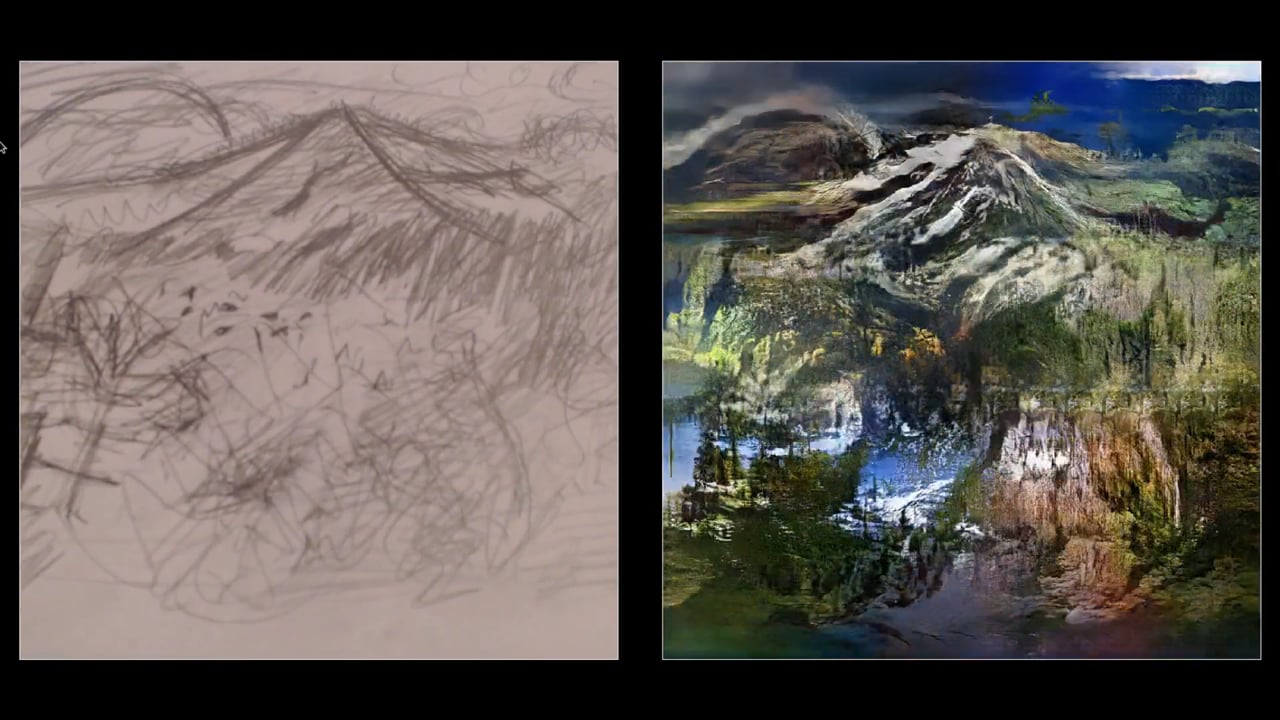
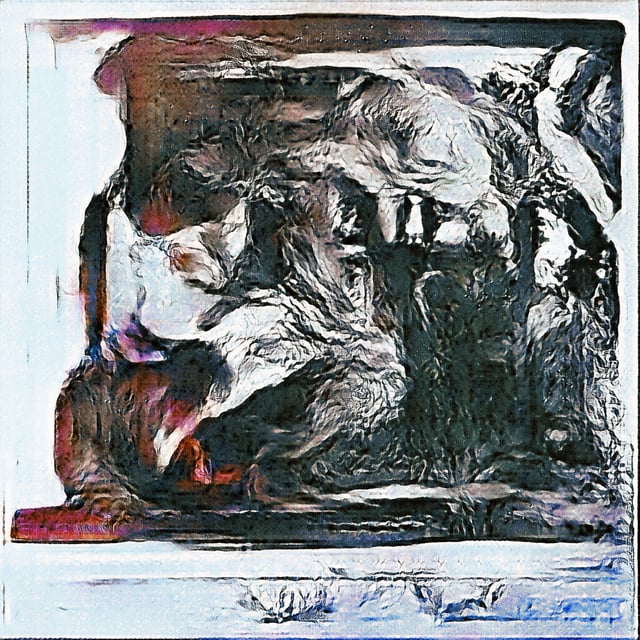
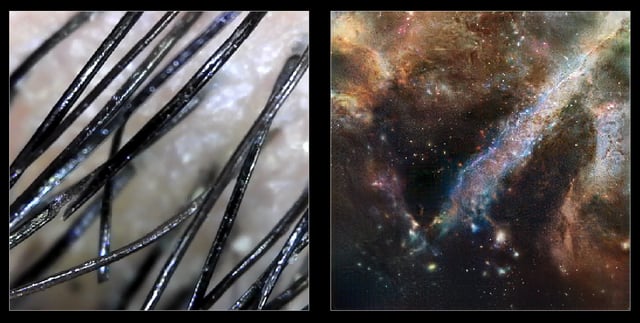
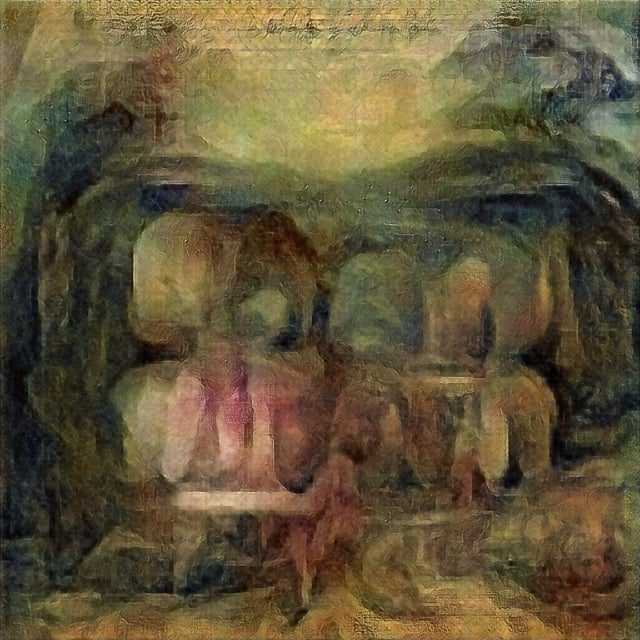
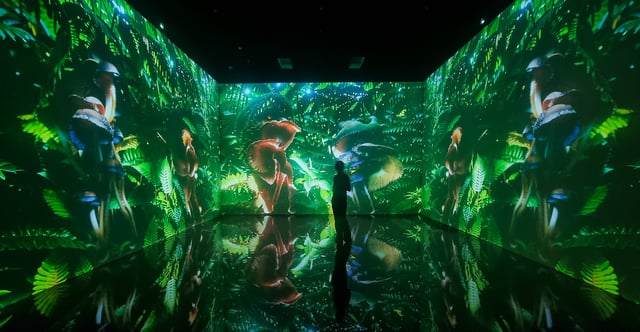
Learning to See is a series of works that use machine learning algorithms to reflect on how our own cognitive biases shape how we ‘see’ and make sense of the world.
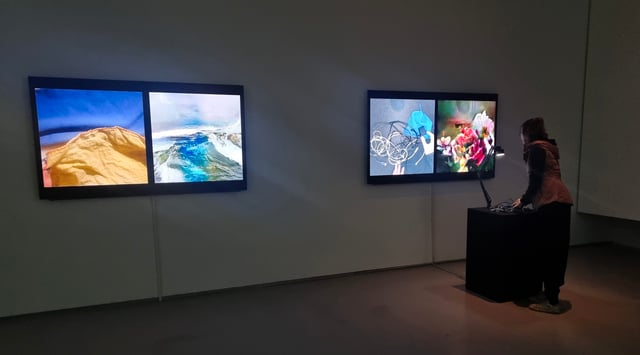
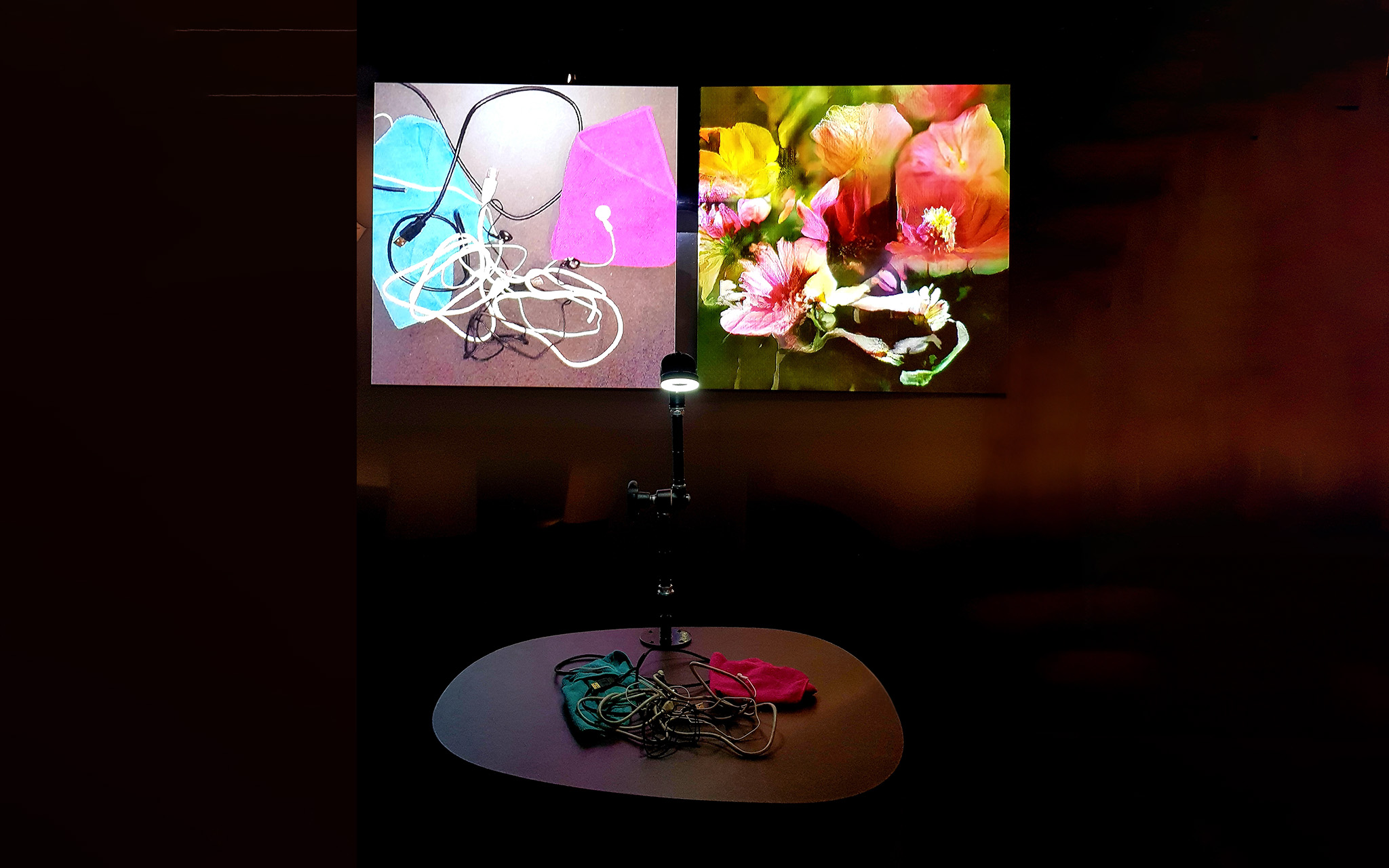
The series includes a number of videos, as well as an interactive installation in which custom neural networks analyse a live camera feed pointing at a table covered in everyday objects, and attempt to reconstruct it in real time, drawing on their prior experience (i.e. training data) and knowledge (i.e. what is learned during training).
An artificial neural network looks out onto the world, and tries to make sense of what it is seeing. But it can only see through the filter of what it already knows.
Just like us.
Because we too, see things not as they are, but as we are.
The work is part of a broader line of inquiry about our cognitive biases, our inability to see the world from others’ point of view, and the resulting social and political polarization.
For a much deeper conceptual and technical analysis, please see Chapter 4 of my PhD Thesis.
A Deep Neural Network (DNN) opening its eyes for the first time, and trying to understand what it sees as it trains in realtime on a live camera feed.
“Hello, World!” is a custom software that performs realtime DNN (CNN-VAE) training on a live video feed, while allowing a user to manipulate a number of hyperparameters in realtime (e.g. using faders on a midi controller). These hyperparameters include learning rate, momentum, gradient clipping thresholds, optimizer function, loss function, regularization weights and many more. Observing the results of these hyperparameter manipulations in realtime, help build a qualitative understanding of how they impact the training process.
Furthermore, it turns out realtime continuous manipulation of hyperparameters while training has great performative potential, turning the training DNN into a Deep Visual Instrument. With realtime continuous control and feedback, it’s relatively trivial (and fun) to find hyperparameter configurations which provide “stable oscillation points”, modulate oscillation frequency and/or amplitude, or create “controlled explosions”.
Finally as the network “learns” more about its environment, it starts projecting its expectations onto the incoming signal. Lots of fascinating emergent properties with regards to “reconstructing memories” and “reminiscing”.
Walkthrough
Moments of interest: 1:58-2:35, 2:47-5:10
This neural network has not been trained on anything. It starts off completely blank (i.e. randomly initialized). It is opening its eyes for the first time and trying to ‘understand’ what it sees. In this context, ‘understanding’ means trying to find patterns, trying to find regularities in what it’s seeing, so that it can efficiently compress and organise incoming information in context of its past experience and make accurate and efficient predictions of the future.
But the network is training in realtime, it’s constantly learning, and updating its ‘filters’ and ‘weights’, to try and improve its compressor, to find more optimal and compact internal representations, to build a more ‘universal world-view’ upon which it can hope to reconstruct future experiences. Unfortunately, the network also ‘forgets’. When too much new information comes in, and it doesn’t re-encounter past experiences, it slowly loses those filters and representations required to reconstruct those past experiences.
These ideas are not behaviours which I have explicitly programmed into the system. They are characteristic properties of deep neural networks which I’m exploiting and exploring.
* One might liken this to a new born baby’s brain. This comparison may appear to work metaphorically; however, it is not entirely accurate. A new born baby’s brain has had hundreds of millions of years of evolution shaping its neural wiring, and arguably the baby is born with already many synaptic connections in place. In this work however, this artificial neural network ‘starts life’ with full architecture in-tact, but all connections are initialised randomly.
For a much deeper conceptual and technical analysis, please see Chapter 4 of my PhD Thesis.
2019 GTC 2019 Keynote with NVIDIA CEO Jensen Huang, NVIDIA, Learning to See shown at 0:32, with the voiceover “[AI is] inventing new ways to bring out the creative genius in us all”, 18 Mar 2019· News· Video
2024 Machine Learning Processes as Sources of Ambiguity: Insights from AI Art, Christian Sivertsen, Guido Salimbeni, Anders Sundnes Løvlie, Steve Benford, Jichen Zhu, Proceedings of the CHI Conference on Human Factors in Computing Systems (CHI ’24), article 165, pp. 1–14, 11 May 2024· Academic paper